A data center has to be built fast, and it has to work from day one. Many trades work side by side, and every technical system must be tested before the facility can go live. On Project Lightning, a 1 GW data center in El Paso, Texas, where Faith Technologies Inc. (FTI) is one of the contractors building for an end client, FTI plans its production with takt planning in TaskCtrl. The project runs on daily takt, with activities placed in fixed time slots through the day.
The takt plan does more than drive production. Checklists and commissioning hang off the activities, so construction and the commissioning plan are tied together from the start.
Why takt planning fits data centers
A data center is made up of many similar units. Halls, rooms and failure domains are mostly built and fitted out the same way. That makes it worth planning the work as trains moving through the areas at a steady pace, and what works in the first area carries straight into the next.
The scale makes coordination demanding. With many contracts and trades on the same site, every team needs to know where to be, and when.
Electrical, mechanical, fire, IT and controls often share a few square meters. The takt plan decides who is where, and when. The go-live date rarely moves, so it helps that deviations show up immediately. In a loose schedule they pile up and only surface near the end.
Takt areas that follow the data center layout
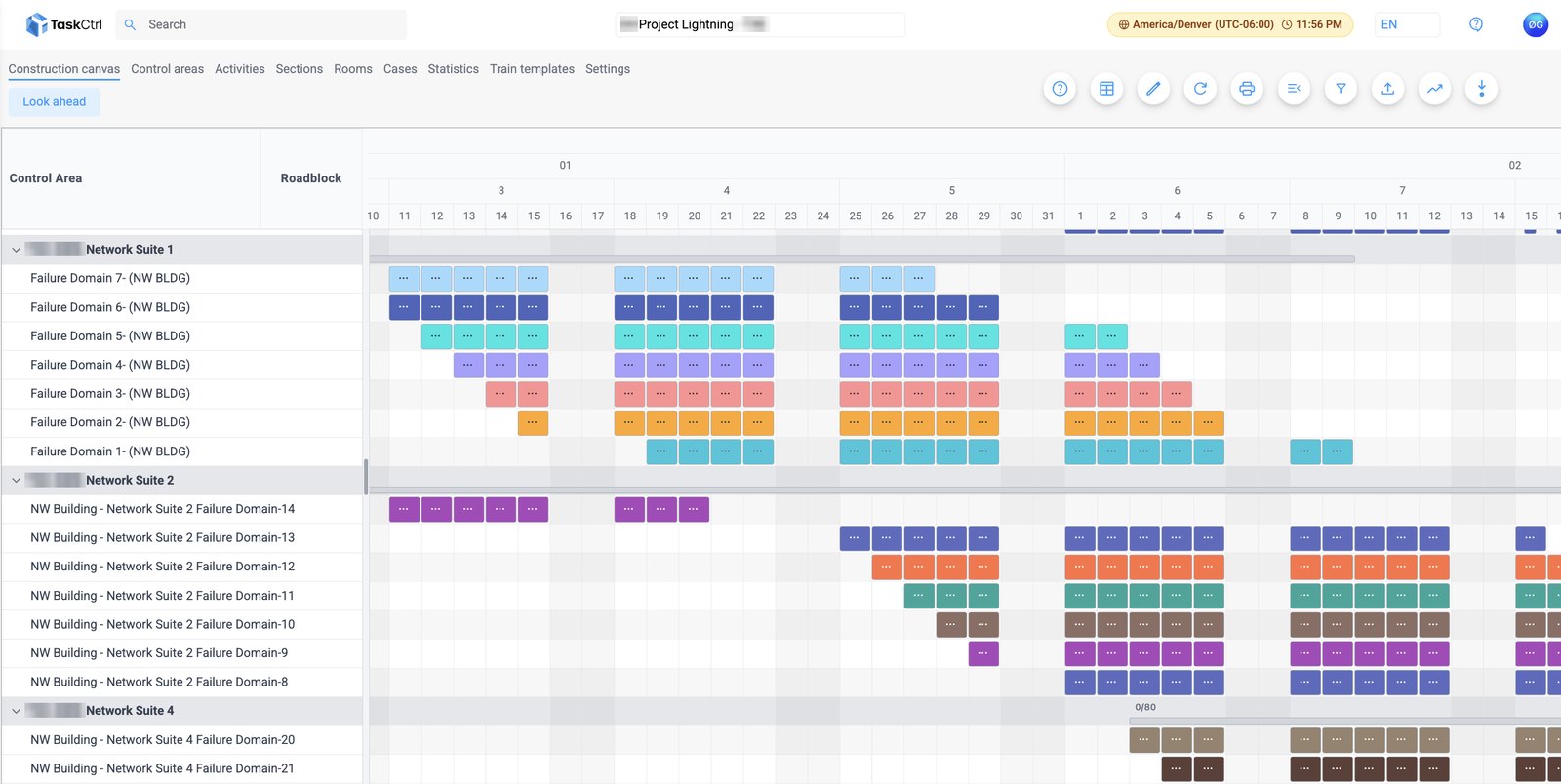
On Project Lightning, the takt areas mirror how the data center itself is divided, into network suites and failure domains. Each train is a fixed sequence of wagons that moves through the areas day by day.
Trains are built from templates, and the same sequence runs in every similar area. In look ahead, the team can see which trains enter which areas over the coming weeks. Roadblocks go straight onto the board, so they can be cleared before they stop the work.
Daily takt with activities split into time slots
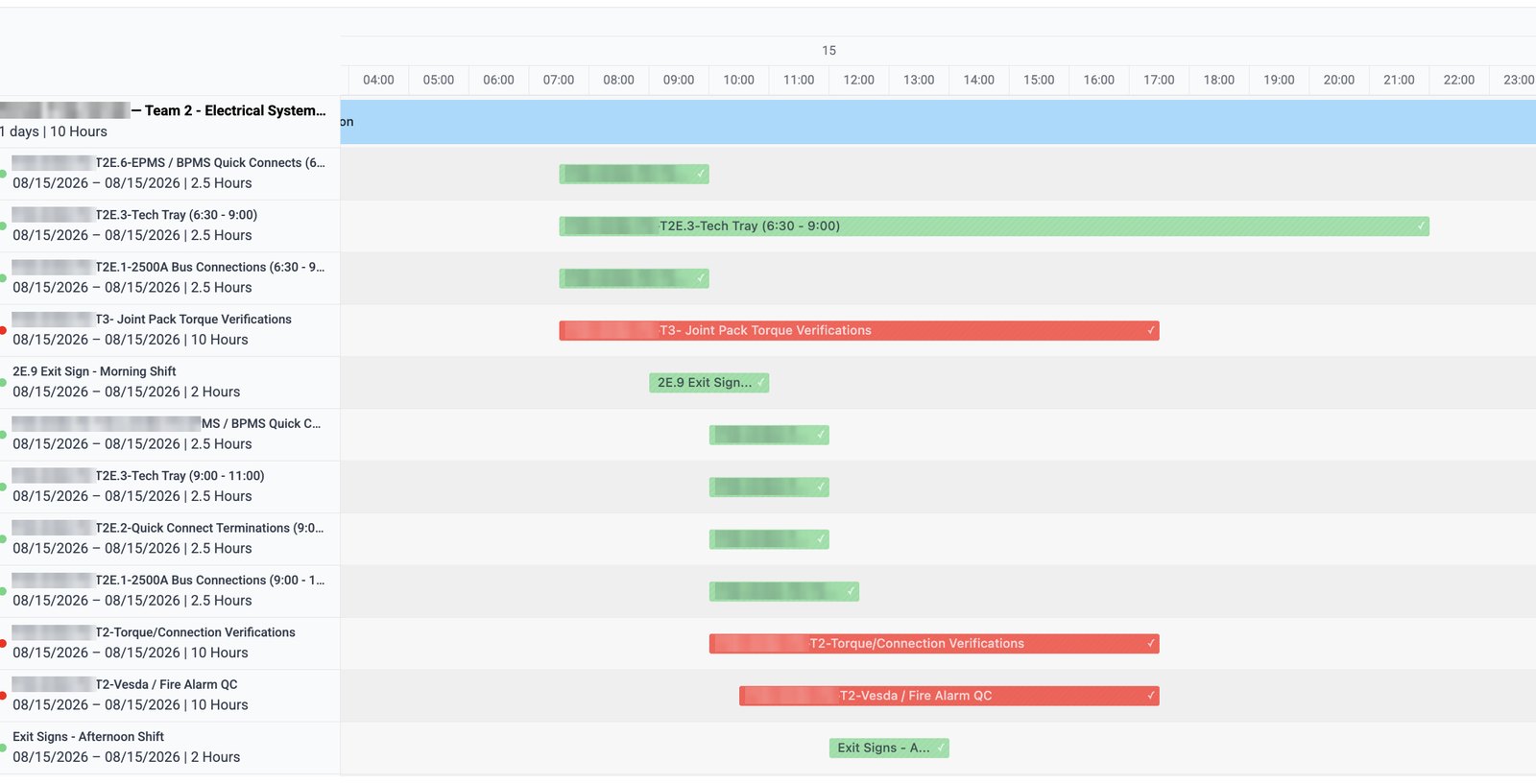
With daily takt, each wagon gets one day in each area. That day is then split into activities with set times. A single day might include bus and tech tray connections spread over several slots, torque verifications and fire alarm and detection checks.
With a plan this fine-grained, there is little slack. A delay has to be dealt with the same day, not at next week's meeting.
Andon and a tiger team
The project borrows its thinking from Andon in manufacturing. When an activity falls behind or has a case raised against it, it shows up live in TaskCtrl on screens around the site. Everyone can see where work has stalled.
A dedicated tiger team stands ready to step in when someone hits a problem or falls behind. Help goes to where the problem is, while the train can still be kept on schedule.
The colors show how the day went. Green means done within the planned time. Red with a done check means the work is complete, but it was set to done after its planned time, or there is a case linked to it. The work is finished, but something should be followed up before the next takt.
Checklists and commissioning linked to every activity
Every activity in the takt plan has checklists and commissioning attached. Whoever does the work opens the right checklist on their phone. Torque and quality checks are recorded where the work happens, and issues are logged with photos against the right area and system.
Once the activities in an area are done and checked, the test plan shows which systems are ready for the next step. The project sees more than what has been built. It also sees what has been checked, and what can be tested.
From takt plan to integrated systems testing
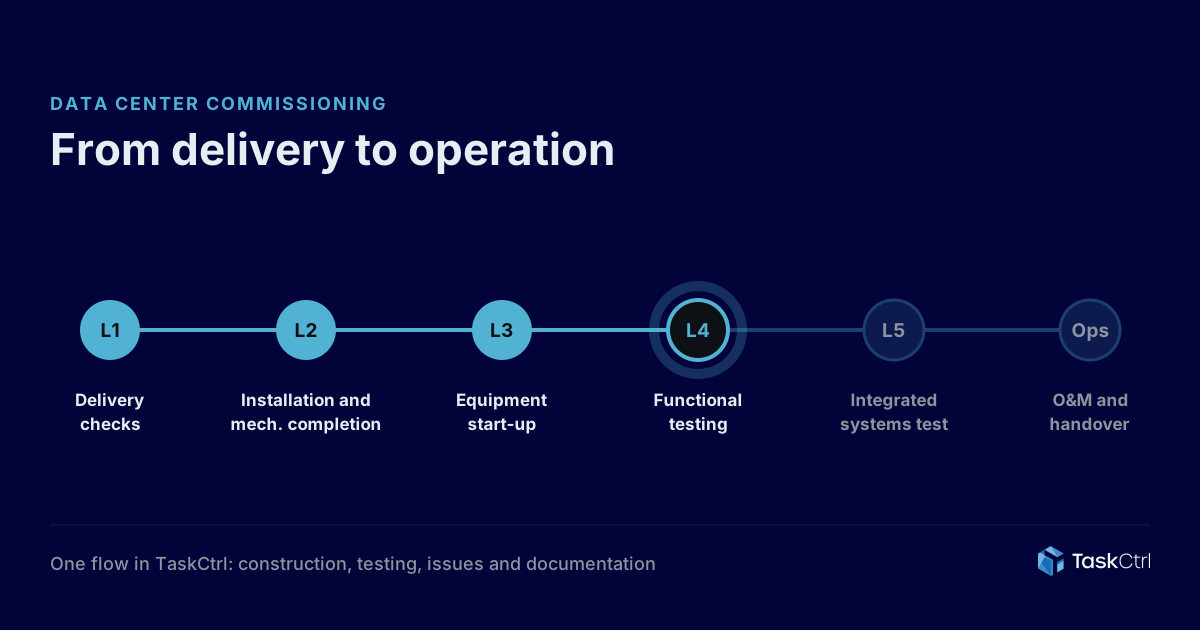
Data center commissioning is usually organized in levels, often called Level 1 to Level 5. Checklists in the takt plan document the installation. The test plan takes it from there with functional testing and finally integrated systems testing (IST) of the whole facility. In Norway, the Guideline for Systematic Commissioning and FMI are commonly used to describe how mature each system is.
Read more about the construction and commissioning modules, and how TaskCtrl AI flags risk across systems.
What the project gains
Construction and commissioning live in one plan, so nobody has to reconcile two systems by hand. Status comes in from the field the same day, down to activity and time slot. Documentation builds up while the work is happening, not in a rushed final phase. And the trains and checklists from the first area can be reused in all the others.
Frequently asked questions
What is takt planning?
Takt planning divides the building into areas and the work into fixed packages that move through the areas at a steady rhythm. Each work package is a wagon, and the train is the sequence of wagons that follow each other from area to area.
What does daily takt mean?
Daily takt means each wagon in the train has one day in each area. Work is planned day by day, often with activities in fixed time slots.
How does the takt plan connect to commissioning?
In TaskCtrl, checklists and commissioning are linked to the activities in the takt plan. When work is done and checked, the test plan shows which systems are ready for testing.
Why does takt planning work well for data centers?
Data centers have many similar areas, many trades working closely together and a fixed go-live date. That makes fixed trains, short takt intervals and early visibility of deviations especially effective.
What is Andon, and how is it used on a data center project?
Andon is a principle from manufacturing where problems are made visible immediately, so help can be brought in fast. On Project Lightning, delays and cases show up live in TaskCtrl on screens around the site, and a dedicated tiger team steps in when someone is stuck.
Read more
Planning a data center project?
We are happy to show how takt planning, checklists and commissioning can be set up for your project.